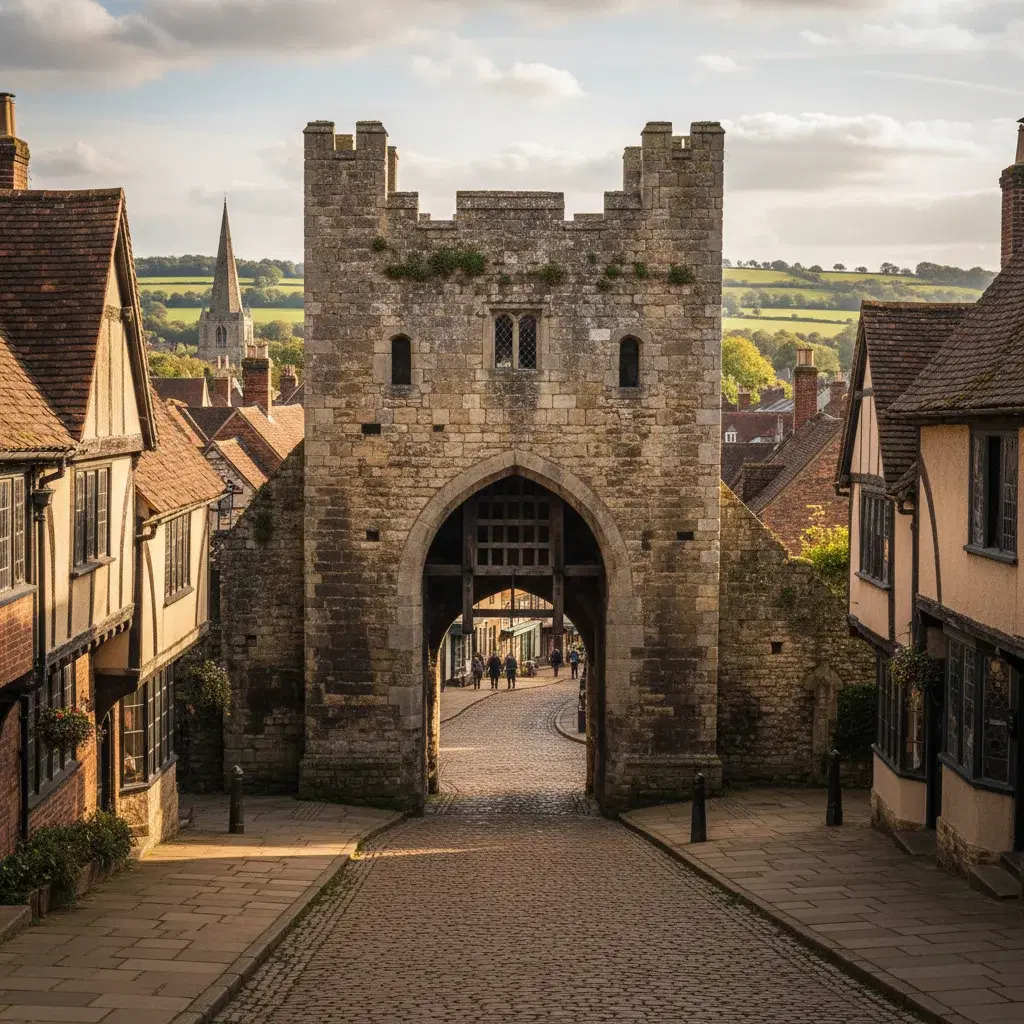
Alnwick's Medieval Gates and Walls
Hotspur Tower, Pottergate Tower, and the medieval town walls -- a walking guide to Alnwick's 15th-century defences, built to protect a border market town from Scottish raids.
Alnwick's medieval town walls are among the most visible reminders of a time when this market town sat on one of the most dangerous frontiers in Europe. Built in the 15th century to defend against Scottish raids, the walls and their surviving towers can still be traced on a short walk through the town centre.
Why Alnwick Built Walls
For much of the medieval period, Alnwick relied on its castle for protection. The town itself was unwalled and vulnerable. Border raids were a persistent threat -- not just from Scottish armies, but from the reivers, the lawless raiding families who operated on both sides of the border.
In 1434, during a period of considerable instability, Henry VI granted Alnwick the right to levy murage -- a tax on goods entering the town -- to fund the construction of defensive walls. The work was overseen by the Percy family, who controlled Alnwick Castle, and it took roughly fifty years to complete.
The walls enclosed the medieval town in a rough circuit, with four gated towers controlling the main approaches: Bondgate Tower, Pottergate Tower, Clayport Tower, and Narrowgate Tower.
Bondgate Tower (The Hotspur Tower)
The most impressive survivor is the Bondgate Tower, which straddles Bondgate Without at the southern entrance to the town. Built around 1450 by the second Earl of Northumberland, it is a substantial stone gatehouse with a pointed archway wide enough for a single vehicle.
The tower is also known locally as the Hotspur Tower or Hotspur Gateway, after Sir Henry "Hotspur" Percy, the famous warrior son of the first Earl. Though Hotspur himself died in 1403 -- before the walls were built -- it was his son who commissioned the defences, and the family association stuck.
Look up as you pass through the arch: the tower is decorated with the Percy lion, the family's heraldic emblem. This is an unusual feature for a town gate. Most medieval town gates celebrated civic identity, but at Alnwick, the Percy family's dominance was such that their crest adorned the public defences.
Best for: The Bondgate Tower is Grade I listed and is one of only two surviving medieval gatehouses in Alnwick. You can walk through its arch on Bondgate Without.
Pottergate Tower
At the north-western edge of the old town, the Pottergate Tower stands at the top of Pottergate, the narrow street that leads up from the Market Place. The original medieval tower was substantially rebuilt in 1768 by Henry Bell in a fashionable Gothick style -- pointed arches and decorative battlements that were more about aesthetics than defence.
The tower was once topped with a crown spire, which was removed in 1812. What remains is an attractive, if somewhat eccentric, gatehouse that blends medieval origins with 18th-century taste. It is Grade I listed.
Pottergate Tower is not open to the public, but it is clearly visible from the street and makes an excellent photograph, framed by the narrow lane rising towards it.
The Lost Gates
Two of Alnwick's four medieval gates have been demolished:
- Clayport Tower stood at the eastern end of Clayport Street. It was demolished in the 18th century to ease traffic flow, and nothing visible remains above ground.
- Narrowgate Tower controlled the approach along Narrowgate. It too was removed, though the narrow street that bears its name preserves the feel of a medieval lane squeezing between buildings towards a gate.
The Town Walls
Fragments of the medieval town wall survive in several locations, though much of the circuit has been incorporated into later buildings or lost entirely. The best-preserved sections can be found:
- Along the south side of the town, between Bondgate Tower and the castle approach
- In the gardens and boundaries behind properties on Narrowgate and Bailiffgate
- Near St Michael's Church, where sections of walling are visible in the churchyard boundary
The walls were never on the scale of those at Berwick-upon-Tweed or Newcastle, but they were sufficient to deter raiding parties and to control access to the market.
A Walking Route
You can connect the surviving gates and wall fragments on a short walk of roughly half a mile:
- Start at the Bondgate Tower on Bondgate Without. Walk through the arch into the old town.
- Head along Bondgate Within towards the Market Place, passing the Dirty Bottles pub (look for the famous sealed window).
- From the Market Place, turn up Pottergate to reach the Pottergate Tower at the top of the hill.
- Return to the Market Place and walk along Narrowgate -- the site of the lost Narrowgate Tower -- towards Bailiffgate.
- Follow Bailiffgate towards St Michael's Church, where you can see fragments of the town wall.
- Continue to the castle approach, where the town's defences connected with the outer works of Alnwick Castle.
Best for: The full circuit takes around 30 minutes at a gentle pace. Both surviving towers are on public streets and can be viewed freely at any time.
Visiting
| Detail | Info |
|---|---|
| Location | Alnwick town centre |
| Access | Free, open at all times (external viewing only) |
| Parking | Greenwell Lane car park or The Pastures (free disc parking) |
| Time needed | 30-45 minutes for the walking route |
| Accessibility | Pottergate is steep; the rest of the route is on pavements |
The medieval gates are best appreciated as part of a wider exploration of Alnwick's town centre. Combine them with a visit to the Market Place, St Michael's Church, and the castle approach for a full picture of the medieval town.
Get in touch if you have historical information or photographs of Alnwick's town walls to share.
Never miss what’s on
Join the weekly Alnwick.live digest — the best events, news and local tips, straight to your inbox. Free, one email a week.
What's On
Si King: In Conversation and Book Signing
10:30 AM · Alnwick Playhouse, Bondgate Without, Alnwick, NE66 1PQ
Dom Joly: Trigger Happy TV 25th Anniversary Tour
7:30 PM · Alnwick Playhouse, Bondgate Without, Alnwick, Northumberland, NE66 1PQ
Heritage Craft Day at Alnwick Castle
10:30 AM - 4:00 PM · Artisans Courtyard and Guest Hall, Alnwick Castle, Alnwick, NE66 1NQ