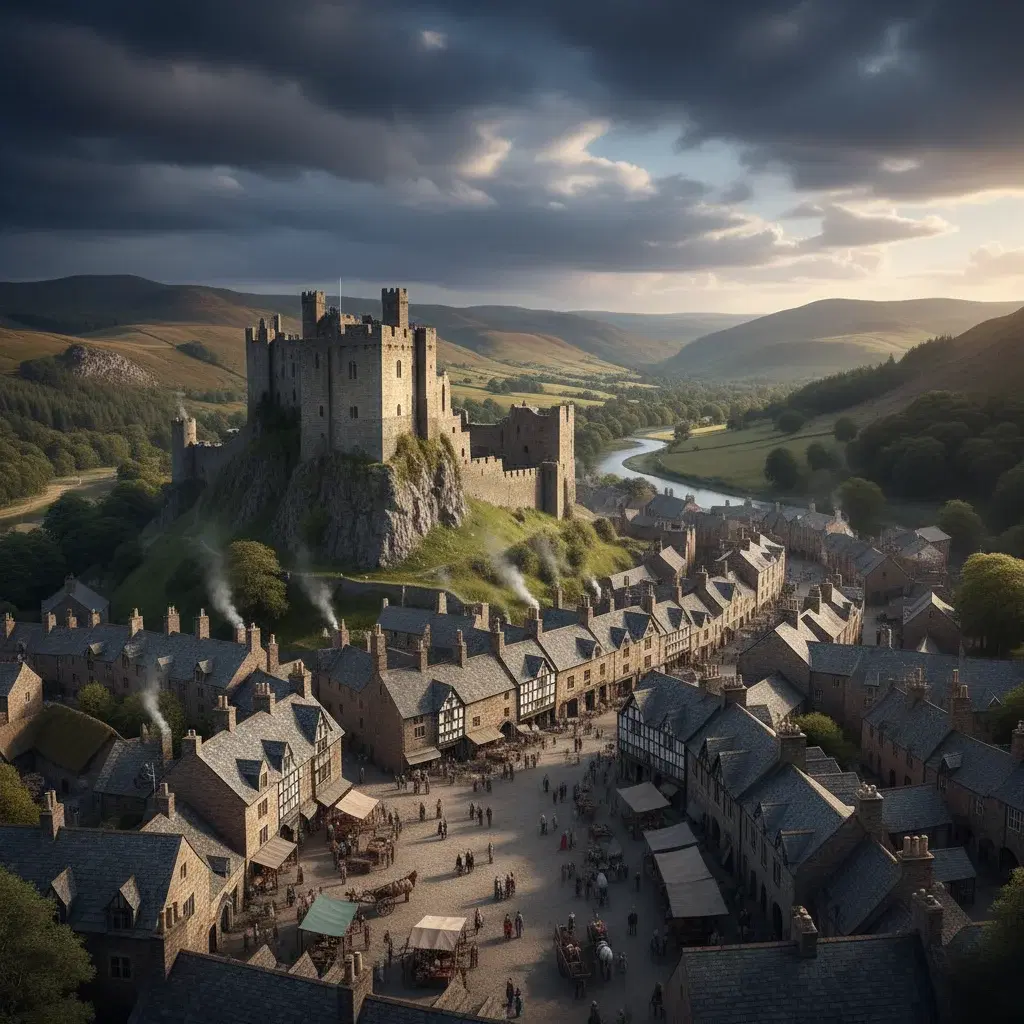
History of Alnwick
From Anglo-Saxon origins on the River Aln through the Percy dynasty, medieval market town, border warfare, and centuries of transformation -- the full history of Alnwick, Northumberland.
Alnwick sits on high ground above a ford across the River Aln, on the ancient north-south route through Northumbria. Its name -- from the Old English Aln-wic -- means simply "the farm or trading place on the Aln". It is a name that speaks of modest beginnings for a town that would become one of the most important settlements on England's turbulent northern border.
Anglo-Saxon Beginnings
The earliest settlement at Alnwick likely dates to the Anglo-Saxon period, when a small community grew up around the river crossing. Northumbria was then one of the great kingdoms of early medieval England, and the Aln valley offered fertile farmland and a strategic route between the Cheviot Hills and the coast.
Little survives from this earliest period. The town's story truly begins with the arrival of the Normans.
The Norman Castle
Following the Norman Conquest of 1066, William the Conqueror parcelled out the north to loyal barons charged with defending it against Scottish incursion. Around 1096, Ivo de Vesci -- a Norman nobleman from Vassy in Calvados -- erected the first stone castle at Alnwick, replacing an earlier wooden fortification.
Unlike many Norman keeps of the period, which were square, the keep at Alnwick was built to a circular plan with towers surrounding a central courtyard -- a layout that survives in the castle's basic form today. The castle was first recorded in 1136, when King David I of Scotland captured it. Even then, it was described as "very strong".
Best for: Alnwick Castle is the second largest inhabited castle in England after Windsor, and has been continuously occupied for over 900 years.
The Percy Dynasty
The castle changed hands several times before the event that would define Alnwick's identity for the next seven centuries. In 1309, Henry de Percy purchased the castle and barony from Antony Bek, Bishop of Durham. The Percys would never let it go.
The family rose to become Earls of Northumberland and the most powerful magnates in the north of England. The first Earl, Henry Percy (1341-1408), and his son Sir Henry "Hotspur" Percy, earned fame and notoriety in equal measure. Hotspur gained his nickname from the speed and ferocity of his raids against the Scots, and his exploits were immortalised by Shakespeare in Henry IV, Part 1.
The Percys were not always loyal subjects. The first Earl and Hotspur rebelled against Henry IV in 1403, and Hotspur was killed at the Battle of Shrewsbury. The family's estates were confiscated and restored multiple times over the following century, but they endured. In 1750, Hugh Smithson married the Percy heiress and took the family name, becoming the first Duke of Northumberland. The current Duke, Ralph Percy, is the 12th to hold the title.
Medieval Market Town
Alnwick grew as a market town in the shadow of the castle. The medieval street plan -- with Bondgate, Narrowgate, and Fenkle Street converging on the Market Place -- remains clearly legible today. Long, narrow burgage plots ran back from the main streets, a pattern typical of planned medieval towns.
The town received its market charter in the medieval period, and the Market Place became the commercial heart of the community. It was not until 1434 that Henry VI granted Alnwick permission to levy murage -- a tax on imports -- to fund the construction of defensive walls. The walls and their towers took some fifty years to complete, encircling the town in stone.
Border Warfare and the Tudors
Alnwick's position just thirty miles from the Scottish border made it a frequent target during centuries of cross-border conflict. The castle was besieged by William the Lion of Scotland in 1172 and 1174, and the town suffered periodic raids throughout the medieval period.
The Percy family played a central role in border defence, serving as Wardens of the Marches. Their castle was both a family home and a military headquarters, garrisoned and ready for conflict. The Wars of the Roses further embroiled the Percys, and Alnwick Castle changed hands between Lancastrian and Yorkist forces multiple times during the 1460s.
Best for: Alnwick Castle was besieged at least eleven times between the 12th and 15th centuries, making it one of the most fought-over fortifications in English history.
Georgian Transformation
The 18th century brought dramatic change. The first Duke of Northumberland commissioned Robert Adam to remodel the castle's interiors in the fashionable Gothic Revival style, while Capability Brown was engaged to landscape the surrounding parkland. Brown swept away the medieval town that had grown up around the castle walls, creating the sweeping views of the River Aln that visitors enjoy today.
The town itself was reshaped during this period. The Pottergate Tower was rebuilt in Gothick style in 1768, and new civic buildings appeared around the Market Place.
The Victorian Castle
The fourth Duke undertook a further wholesale transformation of the castle's interiors in the 1850s and 1860s, replacing Adam's Gothic work with the lavish Italianate State Rooms that survive today. The architect Luigi Canina and artists from Rome created interiors inspired by the Renaissance palaces of Italy -- an extraordinary contrast to the medieval exterior.
Modern Alnwick
The 20th and 21st centuries have seen Alnwick reinvent itself as one of Northumberland's premier tourist destinations. The castle opened to visitors in the 1950s, and its profile soared when it served as a filming location for the first two Harry Potter films in 2001 and 2002.
The Alnwick Garden, opened by the current Duchess in 2002, added a major new attraction adjacent to the castle. More recently, the opening of Lilidorei -- billed as the world's largest play structure -- has cemented the town's appeal to families.
Yet Alnwick remains a working market town. The weekly market still takes place in the Market Place, Barter Books occupies the old railway station, and independent shops line the medieval streets. The Percy lion still looks down from the Barbican, as it has for seven hundred years.
Get in touch if you have historical information or photographs of Alnwick to share.
Never miss what’s on
Join the weekly Alnwick.live digest — the best events, news and local tips, straight to your inbox. Free, one email a week.
What's On
Si King: In Conversation and Book Signing
10:30 AM · Alnwick Playhouse, Bondgate Without, Alnwick, NE66 1PQ
Dom Joly: Trigger Happy TV 25th Anniversary Tour
7:30 PM · Alnwick Playhouse, Bondgate Without, Alnwick, Northumberland, NE66 1PQ
Heritage Craft Day at Alnwick Castle
10:30 AM - 4:00 PM · Artisans Courtyard and Guest Hall, Alnwick Castle, Alnwick, NE66 1NQ