Hulne Priory and Hulne Park
A guide to Hulne Park and its ruined Carmelite priory -- one of the earliest in England, founded by a returning crusader in the 1240s. Free to visit, but no dogs or bikes allowed.
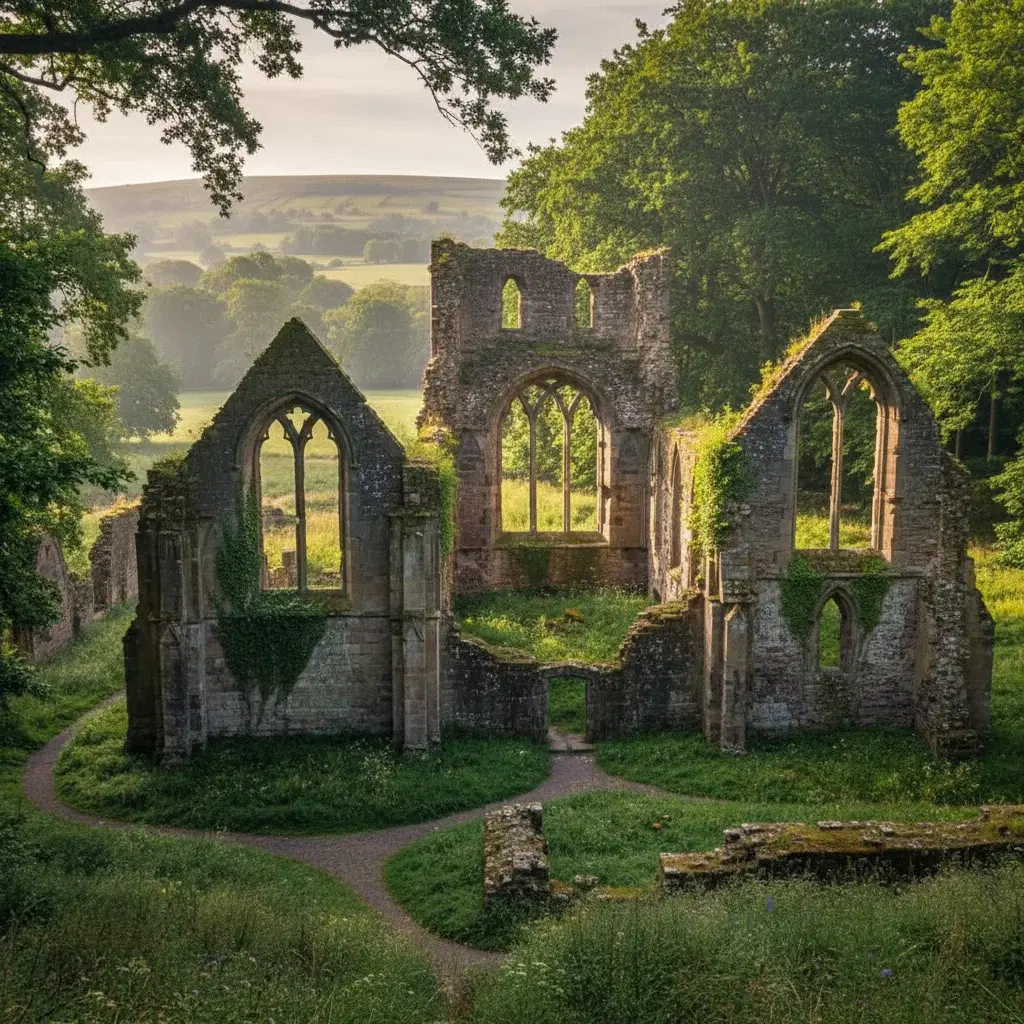
Hulne Park is one of Alnwick's finest assets -- a vast, walled estate of rolling parkland, ancient woodland, and medieval ruins that is free to walk and blissfully quiet. At its heart stands Hulne Priory, the best-preserved and probably the earliest Carmelite friary in England. It is a place that feels genuinely remote, despite being a short walk from the centre of town.
A Crusader's Foundation
The story of Hulne Priory begins in the Holy Land. Around 1240, Ralph Fresburn, a Northumbrian knight who had distinguished himself on crusade, joined the Carmelite hermits on Mount Carmel in what is now Israel. When he returned to England -- probably as part of Richard of Cornwall's expedition in 1241-42 -- he brought a group of Carmelite friars with him.
William de Vesci, Baron of Alnwick, granted Fresburn land on the steep, wooded hillside above the River Aln. The site was chosen deliberately: the remote, hilly terrain was thought to resemble Mount Carmel itself, offering the friars the solitude their contemplative order required.
The priory was founded around 1242, making it one of the very first Carmelite houses in England. Historic England describes it as "the best preserved and probably the earliest Carmelite friary in England".
Best for: Hulne Priory is a Scheduled Ancient Monument. The ruins are fragile -- please do not climb on the walls or remove any stonework.
The Medieval Priory
The priory grew steadily during the 13th and 14th centuries. The Carmelites -- also known as the White Friars, from the white cloaks they wore over brown habits -- were a mendicant order, meaning they relied on alms rather than landed estates. Despite this, the priory at Hulne became a substantial complex.
The surviving ruins include the church, the cloister, a defensive tower added in the 15th century (a reminder of how close the Scottish border lay), and sections of the precinct wall. The 15th-century tower is particularly striking -- a fortified structure that speaks to the very real threat of border raids, even upon a community of monks.
In 1538, the priory was dissolved as part of Henry VIII's Dissolution of the Monasteries. The buildings passed to the Percy family, who incorporated the estate into their deer park. The priory was never demolished wholesale, and its remote position within the park has protected the ruins from the stone-robbing that destroyed so many dissolved monasteries elsewhere.
The Park
Hulne Park is a medieval hunting ground that once supplied food and timber to Alnwick Castle. The entire estate is enclosed by a perimeter wall roughly three metres high, and it stretches to around 3,000 acres of parkland, farmland, and forest.
The park was landscaped in the 18th century by Capability Brown, who worked for the first Duke of Northumberland. Brown's influence is visible in the sweeping views, carefully placed tree clumps, and the picturesque positioning of buildings within the landscape.
Other structures within the park include the Brizlee Tower, an 18th-century Gothic folly on a hilltop to the north, visible from much of the estate, and Alnwick Abbey (a separate Premonstratensian foundation, also in ruins).
Walking in Hulne Park
Three colour-coded circular walks are waymarked through the park:
- Yellow route -- approximately 4 miles, taking in Hulne Priory
- Red route -- approximately 4.7 miles, a longer loop through the parkland
- Blue route -- a shorter alternative
The paths are mostly tarmac or compressed gravel estate roads, making them accessible in most weather. The terrain is gently undulating, with one steeper section climbing to the priory itself. The walk to Hulne Priory from the gate takes roughly 45 minutes each way at a steady pace.
Best for: There are no facilities inside the park -- no toilets, no cafe, no bins. Bring water and anything you need, and take your litter home.
Access Rules
Hulne Park belongs to the Duke of Northumberland, and public access is granted on specific terms:
| Rule | Detail |
|---|---|
| Opening hours | 11am to sunset, daily (occasionally closed for estate events) |
| Dogs | Not permitted, not even on leads |
| Bicycles | Not permitted |
| Vehicles | Not permitted -- pedestrians only |
| Cost | Free |
| Entrance | Via the gate on Ratten Row, off the B6346 Wooler Road |
The no-dogs rule is strictly enforced. This is a working estate with livestock, and the restriction is non-negotiable. If you are visiting Alnwick with a dog, Hulne Park is not an option -- try the riverside walk along the Aln instead.
Visiting
The entrance to Hulne Park is on Ratten Row, a short walk from Alnwick town centre via the B6346 (Wooler Road). There is informal roadside parking near the gate, but spaces are limited on busy days.
Allow at least two to three hours for a walk that takes in Hulne Priory. The priory ruins are unguarded and unmanaged -- there are no information boards, no guides, and no visitor centre. This is part of the appeal. You are walking through a private estate that happens to be open to the public, and the atmosphere is one of quiet privilege.
For closures or access queries, contact the Northumberland Estates office on 01665 510777.
Get in touch if you have historical information or photographs of Hulne Priory to share.
Never miss what’s on
Join the weekly Alnwick.live digest — the best events, news and local tips, straight to your inbox. Free, one email a week.
What's On
Si King: In Conversation and Book Signing
10:30 AM · Alnwick Playhouse, Bondgate Without, Alnwick, NE66 1PQ
Dom Joly: Trigger Happy TV 25th Anniversary Tour
7:30 PM · Alnwick Playhouse, Bondgate Without, Alnwick, Northumberland, NE66 1PQ
Heritage Craft Day at Alnwick Castle
10:30 AM - 4:00 PM · Artisans Courtyard and Guest Hall, Alnwick Castle, Alnwick, NE66 1NQ