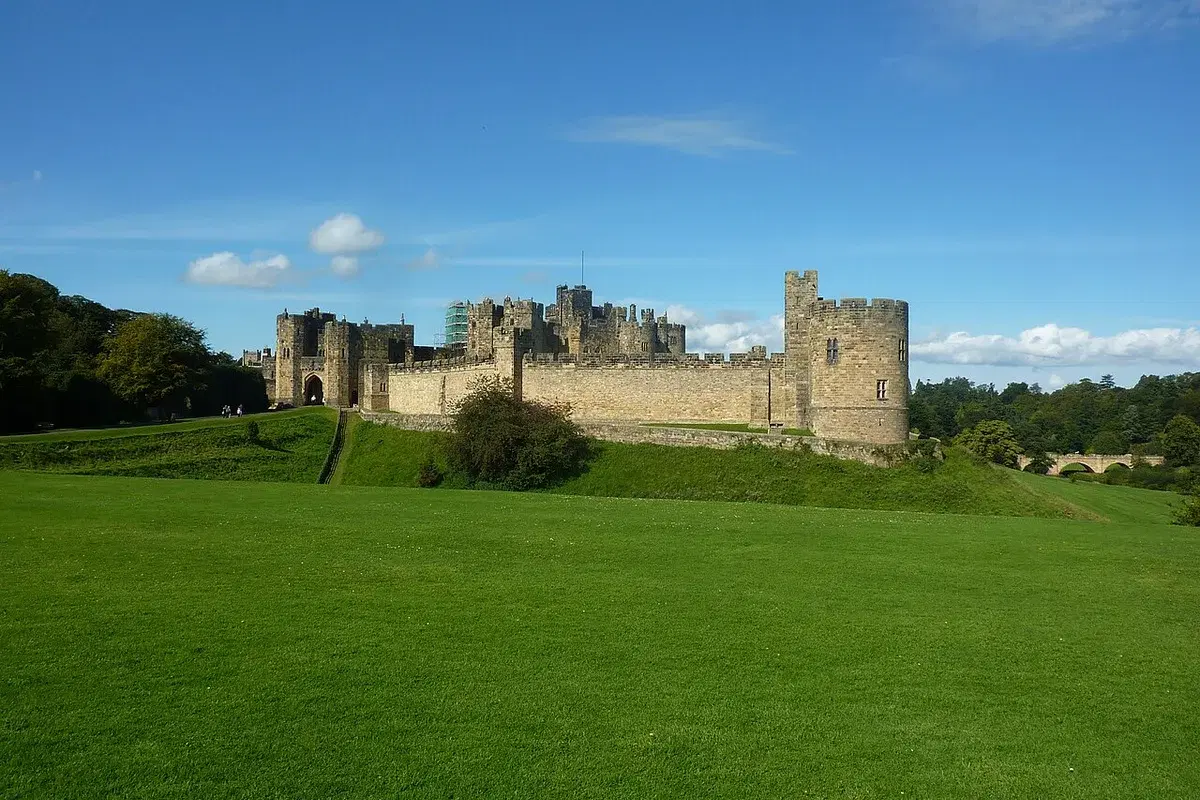
The Percy Dynasty: 700 Years at Alnwick Castle
From Henry de Percy's purchase in 1309 through Harry Hotspur, the Wars of the Roses, the Gunpowder Plot, and the Duchess's Alnwick Garden -- the story of one of England's great dynasties and the castle they have called home for seven centuries.
The Percy family has owned Alnwick Castle for over 700 years. In that time, they have rebelled against kings, fought on both sides of the Wars of the Roses, been implicated in the Gunpowder Plot, transformed a crumbling border fortress into one of England's great aristocratic palaces, and -- in the twenty-first century -- created one of the most ambitious public gardens built in Britain since the Second World War.
No English dynasty outside the royal family can match the Percys for longevity, drama, and sheer resilience. This is their story, told through the castle that has been their seat since 1309.
Before the Percys: The de Vescy Castle
The first castle at Alnwick was built by Yves de Vescy, Baron of Alnwick, shortly after the Norman Conquest -- probably around 1096. It was a simple motte-and-bailey fortification, positioned to command the crossing of the River Aln on the Great North Road between England and Scotland. The de Vescy family held it for two centuries, during which time the castle saw action in the Anglo-Scottish wars. William the Lion of Scotland was captured outside Alnwick Castle in 1174.
By 1297, the de Vescy line had died out, and the castle passed through various hands before reaching Anthony Bek, the powerful Prince Bishop of Durham.
1309: Henry de Percy Buys the Castle
In 1309, Henry de Percy, 1st Baron Percy, purchased Alnwick Castle from Anthony Bek. It was a transformative moment. The Percys were already a wealthy and ambitious Norman family -- they had come to England with William the Conqueror and held extensive lands in Yorkshire -- but Alnwick gave them a power base in the far north of England, close to the Scottish border, where military strength translated directly into political influence.
Henry de Percy immediately began strengthening the castle's defences, and the family quickly established themselves as the dominant force in Northumberland. Within a generation, the Percys were the most powerful family in northern England.
Best for: The Percy family purchased Alnwick Castle in 1309 and have held it continuously ever since -- one of the longest aristocratic occupations of any English castle.
Harry Hotspur: The Most Famous Percy
The most celebrated Percy of all was born at Alnwick Castle around 1364. Henry Percy, eldest son of the 1st Earl of Northumberland, earned the nickname "Hotspur" from the Scots themselves -- a grudging tribute to the speed and ferocity of his cross-border raids. He was, by all accounts, a brilliant and reckless warrior.
Hotspur's life reads like a medieval thriller. He fought at the Battle of Otterburn in 1388, where he was captured by the Scots. He joined his father in helping Henry Bolingbroke overthrow King Richard II in 1399, placing Bolingbroke on the throne as Henry IV. But the alliance soured rapidly. The Percys felt the new king had not rewarded them adequately for their support, and by 1403 they were in open rebellion.
At the Battle of Shrewsbury on 21 July 1403, Hotspur led a rebel army against the king. He was killed in the fighting -- struck by an arrow, according to most accounts -- and his body was displayed publicly to prove he was dead. His father, the 1st Earl, fled back to the north but eventually surrendered.
Shakespeare immortalised Hotspur in Henry IV, Part 1, making him one of the great characters of English literature. In the play, Hotspur is everything a medieval knight should be: brave, headstrong, contemptuous of courtly manners, and utterly fearless. The real Hotspur was probably not far off.
Best for: Harry Hotspur, born at Alnwick Castle around 1364, was immortalised by Shakespeare as the archetypal warrior-knight. His nickname was given by the Scots in reluctant admiration of his lightning raids across the border.
The Wars of the Roses
The fifteenth century was brutal for the Percys. The family were staunch Lancastrians during the Wars of the Roses, the long and bloody dynastic conflict between the houses of Lancaster and York for the English throne.
Hotspur's son, the 2nd Earl of Northumberland, was restored to his family's honours by Henry V, but the peace did not last. The 3rd Earl and three of his brothers lost their lives fighting for the Lancastrian cause. Alnwick Castle itself changed hands multiple times during the conflict, besieged and taken by both sides.
The 4th Earl played one of the most consequential roles in English history. At the Battle of Bosworth Field in 1485, he commanded a significant force but held it back from the fighting. His refusal to commit his troops to Richard III's cause may have tipped the balance of the battle, contributing to Henry Tudor's victory and the founding of the Tudor dynasty. The 4th Earl was later murdered by a mob in Yorkshire in 1489, possibly in retribution for his perceived treachery at Bosworth.
The Gunpowder Plot Connection
The Percy name surfaced again in one of the most dramatic episodes in English history. Thomas Percy, a distant cousin of the 9th Earl of Northumberland, was one of the thirteen conspirators in the Gunpowder Plot of 1605 -- the Catholic plot to blow up the Houses of Parliament and kill King James I.
Thomas Percy was not a minor figure in the conspiracy. He had been appointed constable of Alnwick Castle by the 9th Earl in 1596, making him one of the most senior officials in the Percy household. He was responsible for collecting rents from the Earl's northern estates and held a position of considerable trust.
When the plot was discovered, Thomas Percy was killed while resisting arrest at Holbeach House in Staffordshire on 8 November 1605. The 9th Earl of Northumberland, though not directly involved, was arrested on suspicion of complicity. He spent sixteen years imprisoned in the Tower of London and was fined the enormous sum of 30,000 pounds before his release.
Best for: Thomas Percy, constable of Alnwick Castle, was one of the Gunpowder Plot conspirators. The 9th Earl of Northumberland spent sixteen years in the Tower of London under suspicion of involvement.
The 1st Duke's Transformation
By the eighteenth century, the medieval fortress at Alnwick was in a sorry state. Centuries of conflict, neglect, and piecemeal alteration had left it functional but far from grand. Everything changed when Hugh Smithson married Lady Elizabeth Seymour, heiress to the Percy estates, in 1740.
Smithson took the Percy name and was elevated to 1st Duke of Northumberland by George III in 1766. He was enormously wealthy and determined to match his new title with a suitably magnificent residence. He commissioned the architects Daniel Garrett, James Paine, and Robert Adam to transform Alnwick Castle from a decaying garrison into a palace in the Gothic Revival style.
Robert Adam's interiors were sophisticated and fashionable, but they would not survive long. The 1st Duke also employed Capability Brown to landscape the surrounding parkland, creating the designed landscape of Hulne Park that visitors can still walk through today.
The 4th Duke's Italianate Interiors
A century after the 1st Duke's renovations, the 4th Duke of Northumberland (1792-1865) decided that Adam's Gothic interiors were not grand enough. He commissioned the Italian architects Luigi Canina and Giovanni Montiroli to replace them with lavish Italianate State Rooms modelled on the great palaces of Rome.
The result is the extraordinary sequence of rooms visitors see today: richly carved ceilings, gilded cornices, Venetian mosaic floors, and an outstanding art collection featuring works by Canaletto, Titian, and Van Dyck. The Library alone houses around 16,000 volumes in a galleried room that feels more like a Roman palazzo than a Northumbrian castle.
The 4th Duke's renovation was expensive, extensive, and -- to many Victorian observers -- magnificent. It created the Alnwick Castle that stands today: medieval on the outside, Renaissance Italian on the inside.
The Modern Percys and The Alnwick Garden
The current holders of the title are Ralph Percy, 12th Duke of Northumberland, and Jane Percy, Duchess of Northumberland. They still live at Alnwick Castle, making it one of the few great English castles that remains a genuine family home rather than purely a museum or tourist attraction.
The Duchess has been the driving force behind the most significant addition to the Percy legacy in over a century. In 1997, she initiated the redevelopment of the derelict castle garden into what would become The Alnwick Garden -- the most ambitious new garden created in Britain since the Second World War.
The first phase, designed by Belgian landscape architects Jacques and Peter Wirtz, opened in October 2001. The Grand Cascade, the centrepiece, sends 120 water jets tumbling down a tiered stone structure at the garden's heart. The Duchess added the famous Poison Garden in 2005, containing over 100 toxic, intoxicating, and narcotic plants behind locked gates. In 2024, Lilidorei opened -- the world's largest play structure, a fantasy village of treehouses, towers, and play trails.
The garden, now run by a charitable trust, attracts hundreds of thousands of visitors each year and has contributed an estimated 400 million pounds to the Northumberland tourism economy since opening.
Best for: The Duchess of Northumberland's Alnwick Garden, opened in 2001, is the most ambitious new garden created in Britain since the Second World War. It includes the famous Poison Garden and Lilidorei, the world's largest play structure.
Seven Centuries of the Percys
The Percy story at Alnwick Castle is not a tale of quiet inheritance. It is a story of rebellion, execution, imprisonment, reinvention, and -- eventually -- one of England's most successful cultural transformations. From Henry de Percy's purchase in 1309 to the Duchess's garden in 2001, the family has repeatedly remade both itself and its castle.
Today, the 12th Duke and Duchess continue the tradition. The castle opens to visitors from late March to October, with State Rooms, Harry Potter filming locations, falconry, and live entertainment. The garden is open year-round. Between them, they form one of the great visitor experiences in the North of England.
The Percys have survived the Wars of the Roses, the Gunpowder Plot, the English Civil War, and the decline of the aristocracy. Seven centuries on, they are still at Alnwick.
Visiting Alnwick Castle
For full visitor information -- opening times, tickets, parking, access, and what to see -- read our complete Alnwick Castle guide. For the castle's life on screen, including Harry Potter and Downton Abbey, see Alnwick on Screen. For the medieval defences of the town itself, see our guide to Alnwick's Medieval Gates and Walls.
Local businesses mentioned
Never miss what’s on
Join the weekly Alnwick.live digest — the best events, news and local tips, straight to your inbox. Free, one email a week.
What's On
Northumbrian Pipes at Alnwick Castle
From 10:30 AM, performances through the day · Alnwick Castle, Alnwick, NE66 1NQ
Tom Fool at Alnwick Castle
11:00 AM, 1:00 PM and 3:00 PM · Inner Bailey, Alnwick Castle, Alnwick, NE66 1NQ
Hadestown: The Musical (screening)
4:15pm · Alnwick Playhouse Studio, Bondgate Without, Alnwick, NE66 1PQ