The Lost Buildings of Alnwick
From vanished town gates and a demolished tollbooth to a suppressed abbey and the railway that closed under Beeching, here are the Alnwick landmarks that time, traffic and the demolition men took away.
Alnwick has kept a remarkable amount of its medieval self, from the castle to the Bondgate Tower still standing across the main street. But a town this old inevitably loses as much as it keeps. Over the centuries Alnwick has said goodbye to town gates pulled down to ease the traffic, a great abbey suppressed by Henry VIII, a stone crown lifted off a tower, and a railway swept away in the 1960s. Here are some of the buildings and landmarks that have vanished from Alnwick, and what stands in their place today.
The lost gates of the town walls
When Alnwick built its stone walls in the 15th century, it raised four gate towers to guard the ways into the town. Only one, the Bondgate Tower, survives complete. The others are gone. Clayport Tower stood at the eastern end of Clayport Street and was pulled down in 1804 to ease the flow of traffic through the town, with nothing left visible above ground. Narrowgate had its own gate tower controlling the steep approach towards the castle, and it too was removed, though the tight, hemmed-in street still preserves the feel of a medieval way funnelling towards a vanished gate.
Best for: Best for imagination: stand at the top of Narrowgate and picture the gate tower that once closed the road here.
Pottergate Tower and its missing crown
Pottergate Tower is one of Alnwick's more curious survivors, because it is both lost and standing. The medieval gate that once occupied the spot was replaced in 1768 by the present tower, which may well incorporate some of the original stone. When it was first rebuilt it was a far grander thing than it is now, crowned with a decorative stone lantern or "crown". That crown was taken down in 1812, leaving the plainer tower we see today. So the Pottergate Tower you can visit is really the ghost of two lost buildings, a medieval gate and a taller Georgian one.
Alnwick Abbey, suppressed and swept away
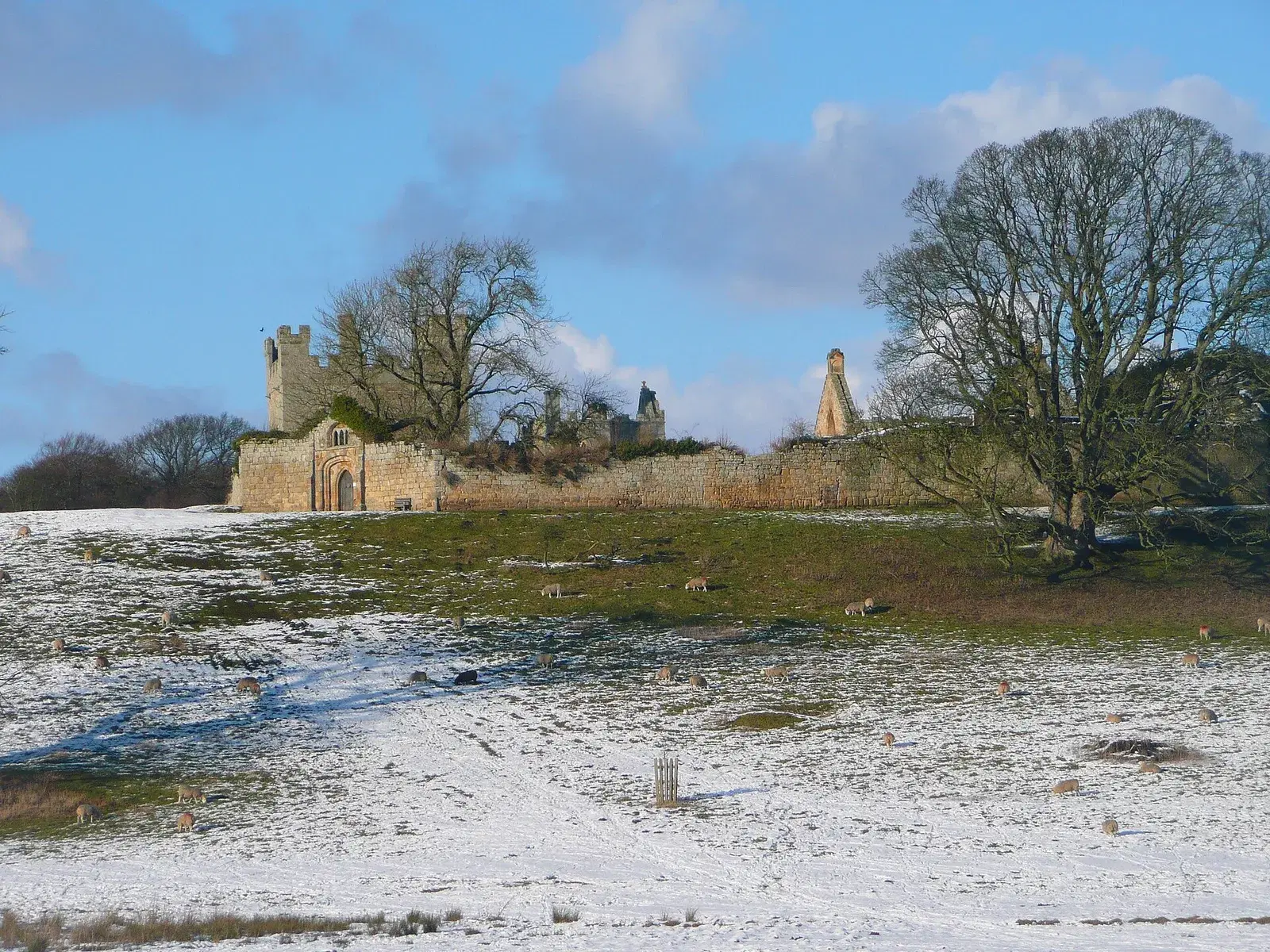
Just outside the town, in what is now the grounds of Hulne Park, stood Alnwick Abbey, founded by the Premonstratensian order in 1147. For nearly four centuries it was one of the most important religious houses in the area, until Henry VIII's dissolution of the monasteries brought it to an end in 1539. Almost the entire abbey was demolished or robbed for its stone. All that survives today is its imposing 15th-century gatehouse, standing alone within the park as a reminder of the great complex that once surrounded it.
Best for: Best for atmosphere: the lone abbey gatehouse in Hulne Park, all that remains of a vanished monastery.
Hulne Priory in the parkland
Deeper into Hulne Park lie the ruins of Hulne Priory, founded around 1242 on a bend of the River Aln and said to be one of the earliest Carmelite houses in England. Like the abbey, it was closed at the Reformation, and it has stood as a picturesque ruin ever since, its church, chapter house and 14th-century pele tower slowly settling into the landscape. It is not lost in the sense of vanished, but it is a great building that ceased to serve its purpose centuries ago and now survives only as evocative stonework.
The old tollbooth on the Market Place
The centre of Alnwick has changed less than most, but one notable building has gone. Before the present Town Hall was raised in 1731, the Market Place was dominated by the town's tollbooth, the old administrative and market building where tolls were collected and civic business conducted. It was cleared to make way for the new hall, whose clock tower still watches over the square. The tollbooth's disappearance is a reminder that even Alnwick's most historic-looking corners are the product of buildings replacing buildings across the centuries.
The railway that closed under Beeching
Perhaps the most keenly felt loss of the modern era was the railway. Alnwick's grand station opened in 1887, built on a scale far beyond the needs of a small market town because it had to be fit to receive the Dukes of Northumberland and their royal guests. It sat at the end of a short branch line running up from the East Coast Main Line at Alnmouth. That branch fell victim to the Beeching cuts, and passenger trains stopped in January 1968. The line was lifted, and Alnwick lost its rail connection. The magnificent station building, however, escaped demolition and found new life in 1991 as Barter Books, one of the largest second-hand bookshops in the country, its old platforms and canopies now sheltering shelves rather than trains.
Remembering what has gone
Much of this vanished Alnwick is preserved in memory and record rather than stone. The Bailiffgate Museum, housed in a former church near the castle, tells the story of the town and its people, including the buildings and trades that have disappeared. It is the best place to piece together the fuller picture of an Alnwick that has lost its gates, its abbey, its tollbooth and its trains, yet somehow remains one of the most complete historic towns in the North East.
Frequently asked questions
Which of Alnwick's medieval town gates survive? Only the Bondgate Tower, also known as the Hotspur Tower, survives complete, still spanning the main street. Clayport Tower was demolished in 1804 and the Narrowgate gate was also removed. Pottergate Tower was rebuilt in 1768 on the site of a medieval gate, so it survives in altered form rather than as the original.
What happened to Alnwick Abbey? Alnwick Abbey was founded in 1147 and suppressed in 1539 during Henry VIII's dissolution of the monasteries. It was almost entirely demolished, and only its 15th-century gatehouse survives, standing within Hulne Park on the edge of the town.
Why did Alnwick lose its railway station? Alnwick's station opened in 1887 at the end of a branch line from Alnmouth. Passenger services were withdrawn in January 1968 as part of the Beeching cuts, and the branch closed. The station building survived and became Barter Books in 1991.
Have a suggestion? Get in touch.
Never miss what’s on
Join the weekly Alnwick.live digest — the best events, news and local tips, straight to your inbox. Free, one email a week.
What's On
Elio Pace Live, Alnwick Playhouse
7:30 PM · Alnwick Playhouse, Bondgate Without, Alnwick, NE66 1PQ
Murder at the Masked Ball, the Alnwick Garden
6:30 PM · The Alnwick Garden (The Pavilion), Denwick Lane, Alnwick, NE66 1YU
Murder at the Masked Ball, Murder Mystery in The Pavilion
6:30 PM - 11:00 PM · The Pavilion, The Alnwick Garden, Denwick Lane, Alnwick, NE66 1YU