Heritage Walking Trail: A Self-Guided Tour of Alnwick
From Alnwick Castle to Barter Books, a self-guided walking trail through 900 years of history -- medieval gatehouses, the Percy dynasty, cobbled streets, and one of the finest gardens in England.
Alnwick is one of the most historically rich small towns in England. Within a compact, walkable centre you can trace over 900 years of history, from the Norman castle that still dominates the skyline to the medieval gatehouses that once defended a border market town, to the grand 21st-century garden that has made Alnwick famous worldwide.
This self-guided walking trail takes you through nine key landmarks. Allow two to two and a half hours at a comfortable pace, with time to stop and look properly at each one.
1. Alnwick Castle
Begin at Alnwick Castle, the seat of the Percy family for over 700 years and the second largest inhabited castle in England after Windsor. Henry de Percy purchased the castle in 1309, and his descendants, the Earls and later Dukes of Northumberland, have lived here ever since.
The castle you see today is a palimpsest of centuries. The medieval shell keep and curtain walls date from the Norman period; Robert Adam remodelled the interiors in the 1760s for the 1st Duke; and the 4th Duke replaced Adam's work with lavish Italianate rooms in the 1850s, designed by Italian architects and craftsmen. The grounds were landscaped by Capability Brown.
More recently, the castle served as Hogwarts in the first two Harry Potter films, the courtyard where Daniel Radcliffe learned to fly a broomstick is one of the most photographed spots in Northumberland.
For the full guide, see our Alnwick Castle visitor guide.
Best for: Alnwick Castle has been the seat of the Percy family since 1309. For the full dynasty story, read our Percy Dynasty guide.
2. Bondgate Tower (Hotspur Tower)
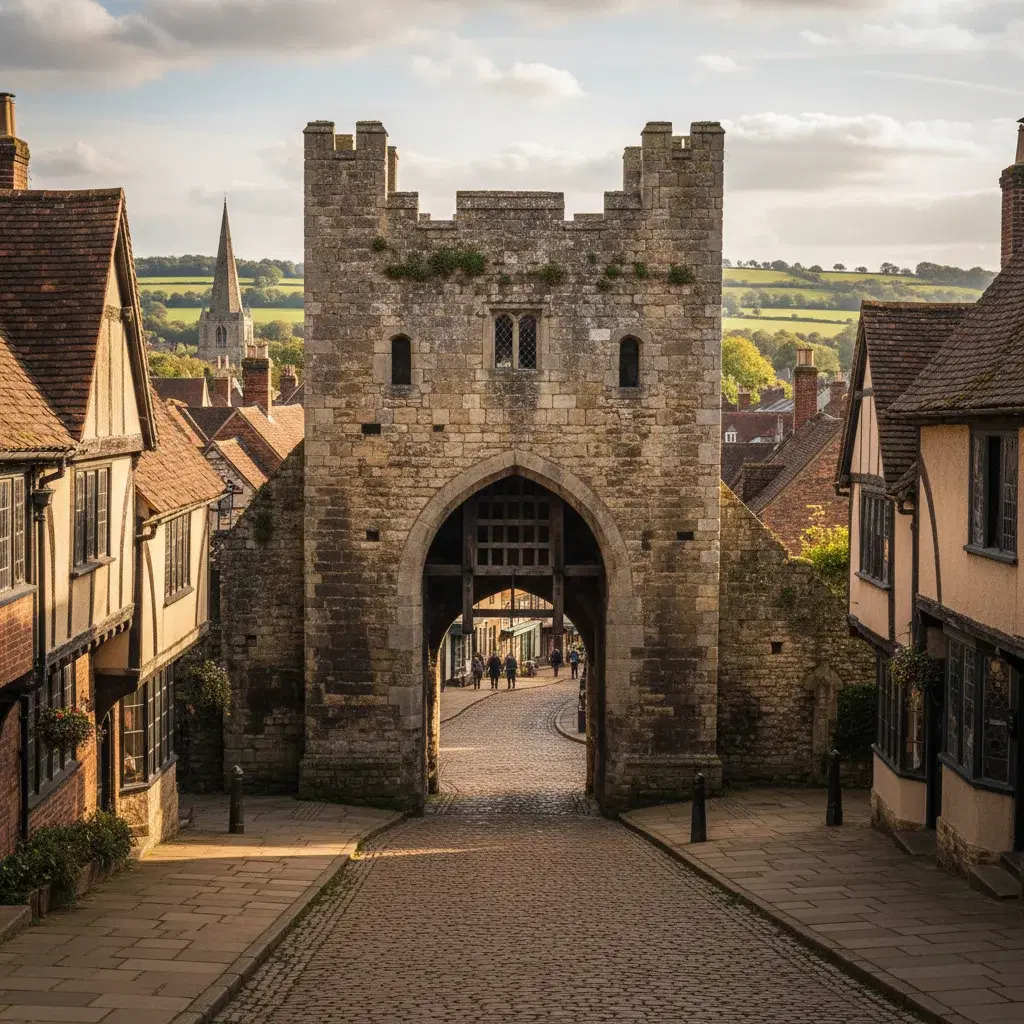
Walk south from the castle along Bailiffgate towards Bondgate Within. At the entrance to the old town you will reach Bondgate Tower, also known as Hotspur Tower, a 15th-century gatehouse built to defend the town from Scottish raids.
The tower is named after Henry "Hotspur" Percy, the eldest son of the 1st Earl of Northumberland, who earned his nickname from the Scots for the speed and ferocity of his cross-border attacks. Born at Alnwick Castle around 1364, Hotspur was immortalised by Shakespeare in Henry IV, Part 1.
The tower's heavy stone arch and flanking turrets give you a tangible sense of what it meant to live in a border town under constant threat of Scottish incursion. Look up at the carved Percy crescent above the arch.
3. Hotspur Tower (Pottergate)
At the other end of the old town, Pottergate Tower is the second of Alnwick's surviving medieval gatehouses. It was built in the same period as Bondgate Tower and served a similar defensive purpose, controlling access from the south.
The tower takes its name from the potters who once worked in the area. Together with Bondgate Tower and fragments of the town walls, it gives Alnwick one of the best-preserved sets of medieval defences in Northumberland.
For a detailed walking guide to all the surviving gates and walls, see our medieval gates and walls guide.
Best for: Alnwick's two surviving medieval gatehouses, Bondgate Tower and Pottergate Tower. Were built in the 15th century to protect the town from Scottish raids.
4. Bailiffgate
Walk back through Bondgate Tower and turn right along Bailiffgate, the elegant street that runs between the castle and the old town. The name comes from the bailiff who administered the castle's estates, and the street has been the address of choice for Alnwick's more prosperous residents for centuries.
Today Bailiffgate is home to the Bailiffgate Museum and Gallery, a local heritage museum housed in St Mary's Church. The museum tells the story of Alnwick and district through artefacts, photographs, and oral histories, and is well worth a visit if you want to go deeper into the town's history.
5. Market Place
Continue south along Bondgate Within to reach Alnwick Market Place, the commercial heart of the town since the medieval period. The market cross marks the spot where traders have gathered for centuries, and a market is still held here every Thursday and Saturday.
The Market Place is surrounded by a mix of Georgian and Victorian buildings, with several notable shopfronts. The Northumberland Hall, on the east side of the square, was built in 1826 as an assembly room and corn exchange, a reminder of the agricultural wealth that sustained the town.
Look up above the modern shopfronts to see the original architectural details: carved stonework, sash windows, and the proportions of a Georgian market town at its most confident.
6. St Michael's Church
From the Market Place, walk a short distance south to St Michael's Church, the parish church of Alnwick. The present building dates mainly from the 15th century, though a church has stood on this site since at least the 12th century.
The church contains several notable Percy monuments and memorials, connecting it directly to the castle and the family that has shaped Alnwick for over 700 years. The churchyard is a quiet spot worth a few minutes' pause.
7. The Alnwick Garden
From the Market Place, follow Denwick Lane north to reach The Alnwick Garden, the 12-acre contemporary garden created by Jane Percy, Duchess of Northumberland, on the site of the castle's derelict walled gardens.
The first phase opened in 2001, and the garden has since grown to include the Grand Cascade (the largest water feature of its kind in the country), the Poison Garden, the Cherry Orchard, the Rose Garden, and the Treehouse, the world's largest treehouse restaurant.
The garden draws over 600,000 visitors a year and has transformed Alnwick's economy. For the full visitor guide, see our Alnwick Garden guide.
Best for: The Alnwick Garden opened in 2001 and draws over 600,000 visitors a year. The Treehouse restaurant is the world's largest.
8. Alnwick Playhouse
Retrace your steps to the town centre and find Alnwick Playhouse on Bondgate Without. This community theatre and cinema is a focal point of the town's cultural life, hosting a programme of live theatre, film, music, and comedy throughout the year.
The Playhouse is housed in a former Corn Exchange building, another link to Alnwick's agricultural past. Its programme mixes touring national productions with local community work.
9. Barter Books
End your walk at Barter Books, housed in the former Alnwick railway station on Wagonway Road. The station was built in 1887 and closed in 1968 as part of the Beeching cuts. It reopened in 1991 as one of the largest second-hand bookshops in Europe.
The shop is famous for rediscovering the original "Keep Calm and Carry On" poster in 2000, a wartime design that had never been publicly displayed. A framed copy hangs above the fireplace in the main hall. The station building itself is a delight: the original Victorian waiting rooms, booking office, and platform canopy have been beautifully preserved and filled with over 350,000 books.
Barter Books is the perfect end to a heritage walk, a building that tells its own story of Alnwick's past, reinvented for the present.
Best for: Barter Books is housed in the former Alnwick railway station (1887) and is one of the largest second-hand bookshops in Europe. It was here that the original "Keep Calm and Carry On" poster was rediscovered in 2000.
Practical Information
- Distance: Approximately 2 miles (3.2 km) in total
- Time: 2 to 2.5 hours at a comfortable pace
- Terrain: Paved streets and paths throughout; some gentle slopes
- Parking: Pay-and-display car parks on Greenwell Road and The Peth
- Refreshments: Plenty of cafes and pubs in the Market Place and along Bondgate Within
- Accessibility: The route is on paved surfaces throughout, but some streets have cobbles and uneven flagstones
For the full history of Alnwick, see our History of Alnwick guide. For more on the castle, read our Alnwick Castle guide and Percy Dynasty article. For the wider heritage of the area, explore our Hulne Priory guide and Alnwick on Screen feature.
Local businesses mentioned
Never miss what’s on
Join the weekly Alnwick.live digest — the best events, news and local tips, straight to your inbox. Free, one email a week.
What's On
Northumbrian Pipes at Alnwick Castle
From 10:30 AM, performances through the day · Alnwick Castle, Alnwick, NE66 1NQ
Tom Fool at Alnwick Castle
11:00 AM, 1:00 PM and 3:00 PM · Inner Bailey, Alnwick Castle, Alnwick, NE66 1NQ
Hadestown: The Musical (screening)
4:15pm · Alnwick Playhouse Studio, Bondgate Without, Alnwick, NE66 1PQ